Pages

Monday, May 23, 2011

Air Pollution in US Cities

Title: "Report names U.S. cities with foulest, cleanest air"

Author: , Reuters 4/27/2011


The American Lung Association recently released a report on the amount of air pollution present in US cities. Thankfully, the study discovered some good news; pollution in the 25 previously "smoggiest" cities has decreased. Honolulu, Hawaii and Santa Fe, New Mexico were found to be the cities with the cleanest air. The report wasn't without its bad news, however. Over 150 million Americans, half the population, are still forced to contend with unhealthy levels of airborne pollutants like ozone and soot. Among the most ozone-polluted cities were Los Angeles and Bakersfield, California while one of the most soot-polluted, Pittsburgh, is right here in Pennsylvania.


It's a good idea to look at statistics/studies every now and then because they can either be indicators of progress or even more problems. In this case, the ALA found mixed results, which is better than the "all bad" news that is so often used just to attract viewers. Anyway, I think it is promising that city governments are taking action about the gray hazes that form over their heads so frequently. This is one of those issues that demands a response, even if it's not strictly for the sake of the environment, because of the bad reputation that smog gives cities. In fact, I think that giving out ratings on the "dirtiest" and "cleanest" air is a great idea because of the motivation it provides to city goverments. As long as a city has a bad rating, politicians will, under pressure of losing votes, take action to make things right.


However, I did find it shocking that "half of the population" lives in areas with unsafe levels of air pollution. It is depressing to discover the many ways in which humanity is paying the price for its embrace of the "money now, thinking later" ideology. I just finished watching the video about Donora that Mrs. D posted on the website, and it has helped me realize that this is exactly the type of thinking that is responsible for the deaths of 20 citizens. People thought only about the money when they installed the zinc refinery in Donora while they failed to consider any impact on people or the environment. The only "smell of progress" in the air was the noxious cloud that blanketed the town and choked all its occupants. This same thing is happening all across the country, and while this reality does bother me, I can't help looking at the flip side. Now that disasters have happened and people are ready to pay attention, real work is being done to undo the mess created by the uninformed previous generation.


How does it make you feel that, according to the ALA, you have a coin toss' chance of living with unhealthy air pollution?


I happen to have really bad allergies, so I know what it feels like to breathe "bad air". Have you felt any physical effects of air pollution?


What would go though your head if you had to choose between public health and economic prosperity like the people of Donora and lawmakers of today?

Saturday, May 14, 2011

China's Trash Problem


Author: Rebecca Boyle, Reuters 8/2/2010


When China built their gigantic Three Gorges Dam, the world's largest hydroelectric facility, they probably weren't counting on it becoming a giant garbage trap. However, according to this article, that is exactly what is happening. The 37.5 billion dollar dam, which is located on the Yangtze River, is not only causing environmental problems but is also accumulating millions of cubic feet of trash. The garbage itself either runs off from the land during rains or is dumped directly into the river upstream. In some places it is so thick that it is possible to walk on the layer of floating waste. Although 3,000 tons of garbage are being removed from the dam every day, Chinese media states that it still has the potential to clog the dam's locks, stopping ships from being able to pass.


This article both put the world's waste management challenges in perspective for me and exposed some of China's issues as a country. I think that it is ironic that the Communist Chinese government built this enormous symbol of power only to have it be compromised by mountains of trash. I also think it's pretty sad that, according to the article, environmentalists had suspected that the dam's reservoir would fill with debris but apparently weren't given much attention. If China has such a huge trash problem, as we saw from the video in class, why is so much effort being poured into giant construction projects rather than solving the issue at hand? Anyway, I feel bad for the Chinese people who have to endure living amongst their own garbage. The video we watched in class really had an emotional impact on me, especially during the scene where a Chinese woman picked through an illegal dump for food. The Chinese government may be working hard to give China a shining face (the Bejing Olypics opening ceremony comes to mind), but beneath all of those theatrics is a nation that is far from perfect.


China, and the whole world for that matter, needs to get on top of the garbage problem. Unfortunately, until a serious disaster happens as a result of the trash (say, the dam does jam or we become buried under tons of waste) I am inclinded to think that attention will be focused elsewhere. Sooner or later, though, all of those high-tech landfills we learned about are going to fill up. I just hope that we will be able to come up with a more long term solution before that time so that we can avoid the turnmoil that a "forced" change would cause.


Do you have any ideas for long-term solutions to the trash problem?


What is your opinion about the actions of the Chinese government?


What is your reaction to the China segment in "The Secret Life of Garbage" along with the issue presented in this article?

Tuesday, May 10, 2011

Using earthworms to Process Hazardous Materials containing Heavy Metals

This article is about the new idea using earthworms to process hazardous material containing high concentrations of heavy metal for the bioremediation of landfills. The new method was created by researchers in South America. Researchers reliezed that worms have been encouraged to process garden waste and soil for generations. They took this idea and realized the Eisenia fetida could be a useful tool in the processing of solid wastes. Scientists performed tests using compost produced by worms as a successful absorbent substrate for remediation of waste. The test was successfull. Earthworms now can be a great bioremediation alternative to complex and costly industrial cleanup methods.


I believe this method is great. We all know that accumulation of solid wastes in landfills causes lots of contamination. Earthworms offer a inexpensive and effective alternate. We are creating more and more hazardous material everyday and soon we won't be able to get rid of it all without harming our environment. Earthworms can save our environment by processing the toxic waste. This article reminded me of when i would play with the worms in my garden when i was little. I never knew what their job as worms were. Earthworms now have a new job. After doing the activity in class on where our trash goes. Landfills are very crowded and these worms could help.


Do you think many countries will start using these worms?
Could these worms really make a big difference in the amount of waste in landfills?
Could our environment be saved by these worms?

Sunday, May 8, 2011


Title: Denmark Boasts a 100% Renewable Community

By: Richars Cook

Publication and date: CleanTechies on Dec 29, 2010


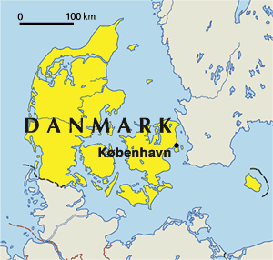
This article is basically about Denmark and how they are on the verge of becoming 100% alternative eneergy country. According to the article, many big companies like Siemens and Vestas are booming there, providing alternative energy sources. The country uses many different types of energy like wind, solar and hydrogen. It is predicted that in a couple of decades, this country will be the first one to be 100% reliant on renewable energy. This project is called the Lolland Hydrogen Project. Not only are they setting up alternative energy plants around the country, they are also turning the excess energy from windpower into hydrogen to be used for other things. This organization is trying to set an example for the rest of Europe and try to get them to do the same.

I think that it is great that countries are now realizing that we do not have unlimited resources and our only way to survive is going to be through alternative energy. I think that if this keeps up, others will start to catch on and try to do the same thing and try to use more aternative energy methods. Along with that, I thought it was really clever how they were using their excess wind energy to make hydrogen. With all the things that is possible with hydrogen, this idea will soon catch on and maybe one day we will all be doing what Denmark is doing now.


Do you think other countries will catch on and start using this idea?

When do you think Denmark will be completely reliant on alternative energy? why?

If you had to persuade the president to follow Denmarks ideas and use more alternative energy, how would you do it?

Wednesday, May 4, 2011

Helios

Helios Prototype:

The forerunner of 21st century solar-powered "atmospheric satellites"

No author
12.01.09
NASA
The Helios Prototype flying wing is shown near the Hawaiian islands of Niihau and Lehua during its first test flight on solar power from the U.S. Navy's Pacific Missile Range Facility.
Helios is a gigantic (247 foot wing span), flying, flexible wing with fourteen propellers spread across the front of it. It has no pilot, but is remotely controlled. It is mostly made of composite materials as to avoid being too heavy. It can fly up to months at a time at altitudes of up to 100,000 feet.
The Helios Prototype flying wing is shown moments after takeoff, beginning its first test flight on solar power from the U.S. Navy's Pacific Missile Range Facility in Hawaii.
The thing is, this is all solar powered, with the optional edition of a fuel cell for flying at night. A fuel cell takes hydrogen and oxygen and combines them to create electricity. However, unlike a traditional gasoline engine, the stuff that comes out of the exhaust pipe is H2O. The 62,120 solar cells on the top of the wing, plus some lithium ion batteries, and plus the fuel cell are what enables this strange aircraft to fly for so darn long and none of these contribute negatively to the environment. All of these energies also allow for an aircraft to travel at 170 miles per hour at extremely high altitudes for extremely long times. The picture below illustrates this.
Helios fuel cell diagram
I think that Helios is a great idea. It seems so cool that you can fly a plane without any gasoline. It really shows that alternative energies do not mean limitations. I hope that someday we will be able to people in these things and send them across the world with no negative effect on the environment or the climate. I can also see Helios being used for a lot of scientific research. They could use it as a satellite that you don't have to send all the way into space.

Do you think that planes like Helios could be used for commercial flight?
How do you think Helios will impact future transportation?
Do you think that these technologies will catch on and someday be in public use?


Monday, May 2, 2011

Brooklyn Bridge Park: Greenest Destination in New York City

Title: Brooklyn Bridge Park: Greenest Destination in New York City
Author: None Given
Publication and Date: Alternative Energy website, April 27th, 2011
Brooklyn Bridge Park
Picture of the new site
they installed by the bridge
In Brooklyn, New York the Brooklyn Bridge Park is getting even greener! They recently added a new solar-powered recharging station for their electric vehicles. They added this to their already lush green parks, and made it an even more incredible spot for the residents and tourists who roam Brooklyn. A renewable energy company that is based in Brooklyn, Beautiful Earth Group (BE), gave this as a gift to the park system. BE is hoping other parks and recreation systems will follow suit and switch to enviornment friendly things like this. The charging system stores the energy into battery packs and then the battery packs get transferred to the trucks. The parks are saving $200,000 in gas prices and preventing apprx. 530 tons of carbon dioxide from being released into the air. You can learn all about the Brooklyn Bride Parks and how they're helping an environmental project, plaNYC, here.
In my opinion, this is a fantastic idea. This is one of the best i've actually heard in awhile. After reading about plaNYC, and the Brooklyn parks I can honestly see that New York is making an effort to help out the environment. I can relate this solar powered machine to the activities we're doing now in science, with the solar and wind stations. It helped me understand a little bit how this could actually be used in real life, and how it can help us make a change in our own communities. Imagine if in future years a lot of our cars were powered by these solar machines! The amount of money and carbon dioxide we would save is rediculous if you think about it!
Do you think that our society could move towards this change?
How effective do you think this would be for our community?
Would you be willing to make this change for the environment?

Monday, April 18, 2011

U.S. Meats Tainted With Bacteria

by Marianne English
Discovery News
Fri Apr 15, 2011
The picture below is staphylococcus aureus also known as staph.

Staph bacteria contaminated nearly half of U.S. meat samples in a recent analysis, with 96 percent of bacteria showing resistance to at least one type of drug. The scientists took meat from five cities and 26 stores. Greater than three fourths of the turkey had staph, chicken and pork had about fourty percent and 37 percent of the beef had staph. the staph in the turkey was resistant to more than three antimicrobials. The scientists also found MRSA. Cooking meals at the right temperature can kill these bacteria. However, you can still get these bacteria from handling uncooked meat. Staph is not included in the list of bacteria that the U.S. inspects for. The authors believe that the overuse of antibiotics has resulted in this.

I think that it is absurd for bacteria like this to be allowed in meat. I can consider myself a carnivore, so this is kind of scary to think that the only thing protecting me from bacteria like staph is the cooking temperature. Farms should stop this overuse of antibiotics because it is leading to these super bacteria.
What is your opinion on this amount of infected meat?
Should this be against the law?
Should the meat industry have to test for staph?

Tuesday, April 12, 2011

Alarming Increase in flow of water into oceansDue to global warming, accelerated cycle of evaporation, precipitation

By: ScienceDaily (oct. 5, 2010)
http://www.sciencedaily.com/releases/2010/10/101004151700.htm

(increased flow of water in river)


This article is about the increase amount of freshwater in our oceans. This is due to Global Warming, more evaporation, and precipitation. Reasearches have learned that 18% more water fed in oceans in 2006 than 1994. Thats a annual rise of 1.5%. The ice caps are melting faster because of increased temperatures. Evaporation and precipitation cycles have increased because of greenhouse gas-fueled higher temperatures. This accelerated cycle can be very dangerous and cause monsterous storms in areas. The increased amount of rainfall might sound good but its not. The increased rainfall is falling in places that dont need it like the artic. Places like desserts are not seeing any more rainfall and starting to dry out.


This article reminded me alot of what we are doing in class lately. We have been doing many melting and freezing point labs. The increase amount of waterlfow is because of hotter temperatures and evaporation. In class we were able to change a solid to a liquid by increasing the temperature surrounding it. The increase water is a example of our lab. The Ice caps are reaching their melting points and beginning to fall apart.


This article was very surprising to me and opened my eyes. I knew that our climate problem was bad but not this bad. When I first started to read this i thought increased rainfall was good but it turns out not to be. The things humans do are starting to impact our environment. I believe that we should stop using so many gases so we can slow down the precipitation and evaporation cycles. If our waters continues to increase we could see very horrible impacts.


What do you think could be some of the long term impacts the increased waterflow could have?


Do you believe the amount of water flowing in the oceans will slow down?


What could we do to help this water problem?


Sunday, April 10, 2011


Title: Ah-Tchoo
By: Starre Vartan
Published by Emagazine
Date: Oct 31 2006
http://www.emagazine.com/archive/3427

This article is basically about the problems of GMO's. In this article, it states that some food with GMO's in them may contain the genes of other organisms. For example, a GMO fruit could contrain the genes from a fish or any organism for that matter. This could cause allergic reactions to people who are allergic to the organism the inserted gene came from. The massive GMO producers say that gene is too small for the human body to react to but scientists say that it is possible to get aa reaction. To stop this, they want to try to follow Europe and have the producers put a label on food telling the buyers that the product is a GMO. Polls state that if these labels were present, 80%-90% of americans would avoid GMO's but the FDA is not looking to do this.

I think that is scary to think that someone could get an allergic reaction to a food that they are not allergic to. I think that they should do more testing to make sure that the gene is small enough to not be noticed by the human body because if it can, it can cause many injuries and deaths. Also, I am sad that the FDA is not even thinking about passing the law to put labels on GMO food like Europe did. I believe that if they did this, it would really help farmers who grow organic food and animals make more money and it would keep the public informed on what they are eating.

This reminded me of the time we created a GMO on our computers in class. It made me realize that the food we eat these days is not all made of the same genes are there have been many upgrades to these foods.

Do you think that we will have labels on food products one day?

If not through labels, how should the FDA inform people the details about GMO's?

Do you think that allergic reactions to GMO foods is a big deal?

Wednesday, April 6, 2011

GMO Mosquitoes Make Their Mark


Title: "What Could Possibly Go Wrong: Genetically Modified Mosquitoes" by Becky Ferreira, Popular Science posted 1/28/11 http://www.popsci.com/science/article/2011-01/what-could-possibly-go-wrong-genetically-modified-mosquitoes


Since conventional methods of mosquito control have begun to fail because of an increased resistance to herbicides, scientists are starting to use genetic modification as a weapon against the pests. Research is being done into this subject by several institutions around the world, including Johns Hopkins University and Oxitec, a British company. The main motivation is to fight the disease malaria, which is carried by the insects and kills millions of people per year.


By altering a gene to make mosquitoes dependent on a substance that they would not be able to find in the wild, scientists hope to shorten their lifespans long enough to drastically affect the population. However, catastrophic side effects would occur if the genes end up being passed into other animals since insects vital to the survival of the ecosystem could die. In addition, the malaria bug has the potential of adapting, rendering the entire GMO strategy useless.


Instead, Joe Conlon, a technical adviser for the American Mosquito Control Association, suggests using non-GMO methods such as larvicide, which kills baby mosquitoes instead of adults. While not as groundbreaking as genetic modification, his solutions would avoid the problems of GMOs entirely.


Generally, I tend to support the use of GMOs because I believe that we humans should utilize our knack for technology and invention in every way possible. However, I do get nervous about the side effects of modifying animals like mosquitoes since we are effectively messing with millions of years of evolution over a very short time. I have experience with computer programming, so I know what it's like to make a small change to the "genetic" code and end up unleashing a chain reaction of unexpected problems. In the end, I think that GMOs would be worth the risks as long as they are put through enough testing to allow the utmost confidence in their stability. Controlling the mosquito population by any effective means would be beneficial to people around the world, and not to mention those in my own backyard!


Do you think GMOs could cure your annoyance toward mosquitoes?

How ethical are the changes we humans are imposing on the genes of our fellow organisms?

What are some postive and negative scenarios that GMOs could create in the future?

Monday, April 4, 2011

Another week, another attempt to shield factory farms from public scrutiny

Check out this article by Tom Laskawy here. Published on March 14, 2011 by Grist

This photo was found on the Florida article
and the caption was "If we just don't look at what's
going on inside factory farms, everything
 will be fine. Right?"
Basically, this article is following up about a bill passed in Florida that makes "it a first-degree felony to photograph a farm without first obtaining written permission from the owner." You can check that out here. The lawmakers in Iowa are now trying to pass a bill that makes it illegal to aquire a job to research it or write about it. While a law like this does not seem as bad as the Florida one (because I mean come on, who bans you from taking pictures?) it does however take a huge toll on journalists and activists. This all started when videos of factory farms and their wrong-doing was released by People for the Ethical Treatment of Animals and the Humane Society. Big Agriculture is trying to help their cause by saying these videos weren't release right away and that the activists are just trying to get attention. People have reported that the likelihood of the Iowa bill passing is not sure yet due to the Democratic control over there.

In my opinion, these laws are absurd. They wouldn't need to be made if Factory Farms didn't have anything to cover up. I find it crazy to believe that people are now being banned from photographing and videotaping the inside of Factory Farms! If something bad is happening, we should know! we should be able to understand what atrocities are going on behind the walls and the food we eat. My personal connection to all this is that my father owns a seafood restaurant down the shore, and all of the fish we buy is freshly caught and local. I'm afriad people won't be able to get this later on down the line due to GMOs and trying to make fish "better."

What do you think of GMOs?
Do you think we can still have good factory farms?
Do you think these laws should get passed in PA?

Tuesday, March 15, 2011

Most river flows across the US are altered by land and water management


Science Daily (nov. 3 2010)


This article is about the alternating flows of water in the US. The amount of water in flowing streams and rivers has changed alot. A study by USGS showed that 90 percent of the waters they tested nationwide, the water movement alternated. The alternation of water has been a effect of both land and water management. Activities like drilling for groundwater, wastewater inputs, and impervious surfaces (parking lots) have changed the water movement. This is having a huge impact on the native species that use the water. Some fish have grown dependent on the flow condition of the water and now face danger. Organisms in these waters are facing great challenges. These alternating movements are having fish that prefer fast moving waters in slow moving waters. More studies are being done to find out how much the water has alternated. The USGS erges us to keep a eye on the water movement.


I agree with the USGS. These changes in water movement are our faughlt. This just shows once again how much we are changing our world. Everything humans are doing is impacting the environment and sometimes cause negative effects. We need to stop causing so many water movement alternations. The fish that depend on the water movement are being killed because they cant survive. We should not be doing this to them. As i read this article i thought of the activity we did in class the other day. We measured accurate conditions about a particuler stream everyday at the same time. We would record the results and see the differences over the past days. This is what the USGS did to figure out the changes in water movement. We learned about the changes the water made just like the USGS. I hope that the waters will change back so the fish can survive.
Do you believe the fish will adapt to the new water movements?
Do you think the water movements will ever change back to normal? why or why not?
If the water continues to alternate, what do you believe will happen?


Monday, March 14, 2011

Many Coastal Wetlands Likely to Disappear This Century

Many Coastal Wetlands Likely to Disappear This Century ScienceDaily (Dec. 3, 2010) http://www.sciencedaily.com/releases/2010/12/101201134256.htm

Image:http://www.wetlands.org/DesktopModules/QuickImageRepository/image.ashx?thumb=1&w=300&fileid=1322

The image shows a destroyed wetland.

When I read this article, I was very suprised. This article is saying that scientist think that many of our coastal wetlands will be destroyed this century. Scientists say that due to the rising sea levels will basically "drown" most of the coastal wetlands. However they say that wetlands with higher sediment availability will have a good chance to survive. This artivle states that if we lose our coastal wetlands, we will be in a lot of trouble in the future. Wetlands absorb energy from storms, clean pollutants out of thew water, and are a home to many different species of birds. If wetlands are destroyed, everyone will face the consequences.

I think that we should do something about this now. This is a serious problem because it can affect humans and animals. If our wetlands do get destroyed, we may be seeing more storms like hurricane Katrina in our country. Also we could see many different species of animals going extinct due to their habitat being destroyed. If I had to try to think of a way to protect these wetlands, I would think about first making sure they are clean and not polluted. Then i would try to put a barrier around the wetland so they cannot "drown". This may cost a little but in the end, it will help us tremendously and maybe save some lives.

If you had to think of something to protect the wetlands, what would you do?

Do you think the wetlands will be destroyed? why or why not

Do you think that wetlands are a valuable thing to have in our country? why or why not?

Wednesday, March 9, 2011

New York City Can Buy More Watershed Land, State Says

http://green.blogs.nytimes.com/2011/02/16/new-york-city-can-buy-more-watershed-land-state-says/?partner=rss&emc=rss

Hudson River
New York City just got an agreement from officials that said they can continue to buy land to protect their watersheds! They can by land to protect the Catskills and the Hudson River Valley from development and they got a permit stating they can continue to aquire the land for the next fifteen years. Environmental officials are very excited about this, as is the city and state officials because this saves them billions of dollars! This land-and-watershed protection effort enables New York to not have to filter their drinking water. The city already has 160,000 acres and the state owns 200,000 so together they have about 35% of the state's watersheds. The acres are expected to increase to 10,000 a year and the state has already spent 400 million dollars on the project and plans to invest 140 million dollars more. The agreement also includes over 100 million dollars to limit water pollution and repairing ceptic systems. Experts say this will provide over half the state with clean drinking water deep into the 21st century.

This article makes me really happy because it shows some people are trying to help and do something about the water problem. The fact that these people are trying to protect their environments and they understand the risks of destroying watersheds makes me want to do something. There are so many people involved in this agreement and it's also nice to see other people taking notice. This gives me hope that other cities and states will follow in New York's footsteps to preserve their watersheds because in doing so they are protecting all kinds of other species too. When I was reading this article I just remembered the activity in class with the fake town and all the pollutants running into that lake and I thought of how bad the Hudson River must be. It makes me glad people are trying to change their actions and turn it around.

Do you think New York could really change from the effects of this?

Do you think other states will try and make this change?

What do you think we could do here, in PA to help our watersheds?

Monday, March 7, 2011

Water Pollution in Mexico


"Riviera Maya", located in Mexico


Title: "Report: Pollution in Mexico Could Hurt Tourism"


by Alister Doyle, Reuters Group - 2/6/2011

When the United Nations supported a study on the Mexican water supply,
they ended up finding a wide range of contaminants in an aquifer beneath a
Caribbean resort called "Riviera Maya". Among the substances found were
pesticides, roadway runoff, and traces of cocaine.

According to author Chris Metcalfe, of the UN University's Institute for
Water, Environment, and Health, the seeping of pollutants into Mexico's
groundwater could have a negative effect on tourism, which is an
important industry for the country. Additionally, the chemicals may
have already helped kill 50% of Mexico's coral reefs.
The study proposed combatting the threat by improving Mexico's wastewater
treatment capabilities. It also suggested that the government control the dumping of
sewage into the ground and begin lining golf courses with materials that will
stop pesticide runoff.

I think that it is quite scary that these chemicals - the cocaine especially - are
being found in water that could end up in a hotel room shower or a resort swimming
pool. The Mexican government should definitely get on top of its water quality
problems if it wants to keep vacationers returning.

My dad often travels around the world on business. When he went to Mexico City,
he told me that he had to drink only bottled water to avoid getting dysentry from
the city's contaminated supply. It's pretty shocking that pollution of this magnitude
can exist alongside tourist hotspots such as Riviera Maya.

If you are a tourist headed to Mexico, what is going through your mind now that you
know about this problem?

We tend to take water for granted here in the states. How would your life be different
if you lived in Mexico City?

Why do you think basic needs such as clean water are getting overlooked while luxurious
resorts flourish?


Wednesday, February 23, 2011

"Coral Moves North to Beat the Heat"

Coral offspring are gradually moving north. Around Japan, coral polyps, or offspring are moving up to eight and a half miles per year. This has been going on since 1930. Coral needs cool water to survive and it seems that global warming is pushing this coral farther north, away from the equator. This may just save the coral from extintion. The polyps are able to grow farther north. The coral is finding a new place to live. Although this may save the coral, the species that depend on it for survival may be out of luck. "For corals it is good news, but for ecosystems, maybe not," said Hiroya Yamano.
This shows just how much we have changed our planet.
Do you think that the corals can be driven back to their native place?
How could this be done?

Wednesday, February 16, 2011

Mountain Mice Show Adaptation to Altitude


ScienceDaily (July 5, 2010)


http://www.sciencedaily.com/releases/2010/07/100701204354.htm

Scientists have found a adaptation in high altitude mice to use oxygen more efficiently than low altitude mice. The Andean mouse species have been able to maximize their energy while little oxygen is in the air. These mice prefer carbohydrates as a source of energy instead of fatty acids. This prefrence has made it possible for them to get the most energy while in such a low oxygen filled environment. While scientists have just recently discovered this, they believe this prefrence for carbohydrates has also been adapted into other mammals. Even high-altitude native humans have adapted this method. The increased use of carbohydrates has been proven to lead to more energy produced.


This discovery has proven to be very interesting and possibly usefull. I think we should see how low altitude humans could get the most energy produced with the oxygen amount surronding them. The method high altitude mice use could be helpfull to us and I think scientists should study more about this species.


Do you believe this adaptation could be helpful to us?


Should scientists study more about these mice and their preference for carbohydrates?


Do you think the high-altitude mice have a advantage over the low-altitude mice, while surviving?

Monday, February 14, 2011

Unleash the Wasps

Scientists now have another problem on their hands. The foreign species of beetle, the Emerald Ash Borer is now multiplying and this is becoming a problem. This beetle got to the U.S from asia in a cargo ship in 1990. Now this beetle is multiplying and causing problems. These beetles are destroying ash trees around the Michigan area and they are now spreading. It will cost the U.S over 7 billion dollars to replace the dead ash trees. Due to this tremendous amount, scientists came up with the idea to release chinese wasps to destroy the larvae of these beetles. Though this seems harmless, this can become a problem. Dr. James Dunn says, "Bringing in an exotic species to control an invasive species can create a lot of problems." Dr Dunn says that there is a lot probability of this plan working and if it does not, it can trouble the native species around the area. Researchers have now found an alternative solution that can also help. It will be a trap that can capture these beetles and now 47/50 states have adopted this idea.

I think that releasing these wasps is not a good idea. It has a low chance of working and can be very dangerous . Along with that, scientists are not sure if they will not attack any native species of beetles. If they do, it can further damage the native species of our country and maybe cause some to go extinct. I think that the trapping idea is a lot safer but not as effective but it can help greatly. Overall, I agree with Dr. Dunn that releasing these wasps can end up bad but if it works out it can be very effective.

What do you think about the releasing of these wasps?
Do you think the plan will work? Why?
What do you predict will happen to our ash trees int he future?

Thursday, February 10, 2011

Lucy the prehistoric primate


Article: "Fossil find puts 'Lucy' story on firm footing"
by Jonathan Amos, Science Correspondant
BBC News - Feb 10 2011

http://www.bbc.co.uk/new/science-environment-12412662

A foot bone from an ancient primate was recently discovered by scientists in Hadar, Ethiopia. The bone helps prove that the species Australopithecus afarensis was able to walk upright in the same way that modern humans do. This adaptation would have allowed it to move quicker and easier than other primates that climbed trees. Scientists believe that the creature lived more than 3 million years ago and was an ancestor of humans. The first skeleton of this species was found in 1974 and was named "Lucy".

I think that it is important for our species to study its origin because we can't expect to understand other things without first understanding ourselves. I hope that this research will help us learn more about how our bodies work so that we can cure disease, create new inventions, etc. Also, this article reminds me of an exhibit that I saw at the National Museum of Natural History that displayed the skeletons of various creatures. Maybe one day our skeletons will be on display and being studied the same way that Lucy's is now!

What are your opinions on the evolution of the human race?
How intelligent do you think Lucy was?
What other adaptations do humans have that make us special among the animals?

Tuesday, February 8, 2011

Coral doctor sounds the alarm about more acidic seas

This article has to do with ecosystems and the carbon cycle. Basically what is happening to our oceans is that the phytoplankton (the base of the aquatic food chain) absorbs 1/3 of the carbon dioxide we put into the air, which slows the process of the greenhouse effects a great deal. But, what some marine biologists are discovering is that this poses a major threat to the ocean life due to acidification. If this process continues at the rate it is moving, it shows a huge problem for the entire marine ecosystem. Scientists have figured out that the ocean absorbs about 22 million tons of carbon dioxide everyday. The problem is the absorbtion is climbing to a rate not seen in millions of years. Measurements have indicated that the acidic level is about 30% more acidic since the industrial revolution. Acid wears down the corals skeletons and that therefore ruins most of the marine ecosystems and food webs. Without them we would be lost because this affects even the smallest phytoplankton to the largest barracudas. The carbon dioxide rate has to be lowered soon, say most scientists, because as John Guinotte says “If marine systems start to crash, it may well be too late to stop the train.”
hello everyone! ;)